Wednesday, 1 April 2015

Back to the 1860s

Hello and thank you for calling in.  Thanks, too, to those of you who left comments on my last post - it is so nice to know that I am not the only grown-up in the world who loves shells!  I do have some more, collected on Sanibel Island in Florida in 1999 and still carefully wrapped in newspaper and stored away.  Maybe I should give them an airing?
 
One of my hobbies is researching my family history and I would like to share some of that with you here occasionally.  There is nobody famous or grand in my family tree, I come from a long line of what my mother calls "good peasant stock", labourers both agricultural and industrial, but to me they are all interesting.  What were their lives like?  Why did they move from country to town?  How much of them can I find in myself?

Alice Stapleton was born in March 1861 at 5 Brady’s Place, Greycoat Street in Westminster, right in the heart of London.  She had an elder sister, Mary Ann, named after their mother, and it seems that her parents, Mary and Benjamin, a stonemason's labourer, had trouble choosing another girl’s name because when the national census was taken eleven days later, the space for her name was left blank and she is simply recorded as a Daughter, aged 2 weeks!  She was eventually registered as Alice on 29th April. 

A younger sister, Caroline, was born four years later and in 1866, when Alice was 5 years old, her father died, leaving 28 year-old Mary Ann to bring up their three daughters alone.  Mary Ann got a job as a “Charwoman”, a cleaner.  Her life must have been hard – but there must also have been some fun because four years later, she gave birth to a baby boy!
 
On Christmas Eve 1879, Alice married a young waiter named Thomas Edward Green at St Margaret’s Church in Westminster, a church which crops up on both sides of my family tree.  I have an old postcard of the church –


 Can you see Big Ben?  Yep, this church is right next to the Houses of Parliament.  Alice was 18 years old but lied about her age as the marriage certificate states that she was 21 – perhaps she lied to get round the requirement for parental consent, necessary for under-21s at that time?  The 1881 census records that Tom was working as a “Liftman (Domestic)” – presumably that means that he operated a lift?  (The last time I went to Liberty’s in London there was a man whose job was to operate the lift.  It’s a sort of obsolete occupation now, I suppose.)  Soon after that, the couple settled down to the business of having children: Thomas, Albert, Arthur and Caroline in the next ten years, by which time Tom’s widowed mother was also living with them.  This family of seven people lived in 4 rooms in a property in Walthamstow, supported only by Tom’s wage as a labourer.  Life must have been very hard – no housing benefit, tax credits or child benefit then!  Then two more daughters came along, Mary and Jane (known as Cissy), before Tom died in 1896.  So, there was Alice, widowed at the age of 35 with 6 children to feed.  Life had got considerably harder.

So what did a woman do in the days before the welfare state if she was widowed and had dependent children?  She found another husband, that’s what she did!  Three years later she married 46-year-old James Huckle and you know what comes after a marriage...a baby.  Jim was named for his father.  A year later, Alice reached her 40th birthday.  And sadly, a year after that, Alice was widowed for the second time.  But she wasn’t done yet: a year later, at the age of 42, Alice had another baby, Evelyn.  Goodness knows who her father was. 

The 1911 census records Alice living with 6 of her children in 6 rooms in a property in Hackney in East London.  Arthur was working as a bricklayer and Carrie, Mary and Cissy were working in a laundry so there were 4 wages coming in.

Alice didn’t marry again.  In the days when a woman supposedly needed a man to “look after” her she had been left by her father and two husbands.  She must have been tough.  A woman born in 1861 had a life expectancy of about 40 years but Alice died in November 1941 at the age of 80.  See what I mean?  Tough.  She was buried in Abney Park Cemetery in Stoke Newington, where her daughter Caroline had been buried two years earlier. 
 
 
This photo was taken in about 1930.  There’s Alice on the left, the woman in the middle is her daughter Caroline, next to her is Evelyn and finally, on the right, is Caroline’s daughter Julie, my Nanny.  What fabulous hats!

So there you are.  An ordinary life, nothing spectacular, the kind of life that millions of women born in the Victorian era must have had.  Her father died when she was 5 years old, she was widowed twice before she was forty, she was poor and she brought up eight children in circumstances we can’t really imagine, but that’s what life was like.  She lived through the reigns of five British kings and queens, the discovery of the South Pole, the first aeroplane flight, the sinking of RMS Titanic, the First World War,  the first two years of the Second World War and incredible social and industrial change. 

She was my great, great grandmother.  I carry her genes.
 
 
Love, Mrs Tiggywinkle x


Friday, 27 March 2015

Five On Friday

Hello, thank you for dropping in.  I am trying something new today and joining in with Amy at Love Made My Home for Five On Friday so if you have dropped in here via there, welcome to my Shropshire patch.  Last time I told how I marked the first day of spring by doing some spring cleaning, wiping away the old season and making room for the new.  As part of this process, I put away some decidedly wintry decorations and in doing so, I came across this -

 
It's a battered old biscuit tin, more than 40 years old, but it holds treasure.  Would you like to have a look inside? -


Seashells!  I have been collecting seashells and storing them in this tin since I was a small child (I must add that this is not the only place I have been storing them!).  I can't help myself.  Every time we go to a beach I have to pick up at least one shell.  I think they are beautiful and fascinating, nature's treasure indeed.  I have limpets, whelks, periwinkles, cockles, oysters, scallops, razor clams, tellins, dog whelks...lots of shells and I would like to share five of them with you today.
 
 
Slipper limpets, crepidula fornicata.  These are the ones which started it all off for me.  I remember them being all over the beach when I was on holiday in Swanage in Dorset when I was 6 years old and I think that's when my mother gave me the tin to keep them in.  I didn't realise then that I would only ever come across them in the south of England.  (That holiday was notable for another reason: the first time I wore my hair in BUNCHES!)


Topshells, gibbula umbilcalis and gibbula cineraria.  When I was ten years old, my parents rented a cottage in Portloe in Cornwall for a fortnight's holiday.  The cottage was a few yards from the beach and in the evenings, my younger sister and I were allowed to go down there by ourselves for a short while. How very grown up I felt!  That was the first time I saw these shells and I thought they were quite precious with their iridescent mother-of-pearl decoration.  I think they may still be my favourites. 
 
 
Pelican's foot shell, aporrhais pespelecani.  I found a few of these on the beach at Creetown on the Solway Firth in the late 1970s and was very excited because my children's nature book said that they were rarely found on the shore!  I found a few more on the beach at Blackpool in the early 1990s.  Apparently they live in the Eastern Atlantic.


Mussels, mytilus edulis.  Forme, these are forever associated with a wonderful family holiday in Brittany for four generations: my grandparents, parents, sisters, husband, daughter and me.  It was 1991 and The Teacher was nearly 2 years old.  There were fascinating mussel farms nearby and mussels heaped on trestle tables in the local market.  Delicious. 
 
 
Cockles, cerastoderma edule.  I have found these on beaches everywhere I have been: Devon, Cornwall, Dorset, Hampshire, Kent, Yorkshire, Anglesey, Pembrokeshire, Lancashire, Ayrshire, the Solway Firth...the humble cockle is always there.  And I always associate them with my grandparents' East London weekend tea table, drenched in vinegar!  "Alive, alive, oh!"

My treasure.  Why on earth have I kept it shut away in a tin?  Well, no more. I have put some of it into a glass vase and put it out on display so that I can see it every day, reminding me of summers past and hinting at those yet to come.
 
Do you know The Nature Carol?  I think it's a traditional song from The Philippines.  We learnt the Malcolm Sargent translation at primary school and I love the first verse -

Coral, amber, pearl and shell,
Gifts we gather from summer seas,
Find and bind make love the spell,
Take our gifts if they charm and please.

 
Well, they certainly charm and please me.  I hope you can see why.

Love, Mrs Tiggywinkle x
 PS If you hop over to Love Made My Home by clicking on this link you will find links to today's other Five On Friday blog posts.   And THANK YOU Amy for hosting these Fridays.


Sunday, 22 March 2015

An Astronomical Kind of Gal

Hello.  Thank you for calling in.  Friday was SUCH a day, wasn't it?  20th March 2015: vernal equinox and partial solar eclipse.  WOWEE!
 
I have mentioned before that I am an astronomical kind of a gal.  When I studied O Level Physics we had to learn some basic astronomy and our teachers let it be known that they all disliked it but I couldn't understand why because it fascinated me, it always has done, much more so than bits of ticker tape and sending little vehicles down ramps.  Don't get me wrong, my knowledge is very, very basic, but I am prone to wandering outside on clear nights, winter and summer, to gaze up at the stars in wonder.  The Mathematician always associates Orion with her birthday (January), the huntsman having been pointed out to her since she was very small, and only being visible in the northern hemisphere between January and March.  The Teacher can recall being woken up in the middle of the night when she was 5 years old to be taken outside to sit on the top of her climbing frame with her binoculars to watch a lunar eclipse.

Amazingly, we had a clear blue sky for Friday's solar eclipse.  I say "amazingly" because we always try to watch the Perseid and Leonid meteor showers in August and November and it is ALWAYS cloudy!!  We have never seen them here - although I did catch a spectacular glimpse in the skies over Scarborough a few years ago, just before the clouds closed in.  And August 1999, the last time we saw a partial eclipse?  Yep, cloudy. 

So, I realised that the sun was streaming through the back gate directly onto the front of the shed.  Perfect sunshine!  I wedged the gate open to lose its shadow, tore a piece of card from an empty cereal packet and made a hole in it with a 2.5mm knitting needle.  Result: pinhole camera.  Cost: £0.  This is what I saw -


I had the BBC Stargazing team on indoors and kept nipping back inside to watch their fabulous pictures, especially as the eclipse reached totality - Baily's beads, the diamond ring, the corona.  This is what I saw on my shed -


I know that it's very amateurish, that there are absolutely stunning photographs all over the internet, but the point is that I didn't just sit indoors and watch the eclipse on a media screen, I was outside experiencing it and my photos are a record of my experience.  I know that the light level dropped about ten minutes before the peak of the eclipse and lifted again about ten minutes afterwards because I saw it, and I know that the temperature dropped by a few degrees during that time because I felt it.  I also felt ridiculously excited!  I think we are the only planet in the solar system which has solar eclipses, and it is simply coincidence that the sun and moon appear to be the same size in the sky, the sun being about 400 times larger than the moon but also about 400 times further away from the Earth than the moon.  COINCIDENCE!!!!  An astronomical coincidence which I was able to experience in my back yard in Shropshire.  A-MA-ZING.

And the equinox?  The Earth spins on an axis, through the north and south poles, which is tilted relative to its orbit around the sun. When the north pole is tilted towards the sun, it is spring and summer in the northern hemisphere; when the south pole is tilted towards the sun, it is autumn and winter here in the northern hemisphere.  There are 2 points in the year when the poles are both the same distance from the sun: the spring and autumn equinoxes.  At these points, day and night are of equal length.  From Friday until the autumn equinox, the north pole will be tilted towards the sun. If the axis were not tilted, day and night would always be of the same length, we wouldn't have long summer evenings, we wouldn't have any seasons giving rhythm to our lives, a rhythm which I love.   

So Friday was the first day of spring, officially.  The sun returned to the northern hemisphere (or rather, the northern hemisphere tilted towards the sun).  From now on, the days will lengthen, the sun will climb higher in the sky and the temperature should rise.  It's a time of reawakening and renewal and ... spring cleaning!  And that is how I marked the day, with a spot of spring cleaning, wiping away the old season and welcoming in the new, giddy with happiness and excitement.  It felt REALLY good.   

See you soon, after I've calmed down a bit! 

Love, Mrs Tiggywinkle x 


Tuesday, 17 March 2015

A is for Alpaca

Hello lovelies, thank you for calling in.  First things first: La Fheile Padraig Sona Daoibh!  In other words, Happy St Patrick's Day to all of you who are celebrating. 

Today I am going to reveal to you another of my favourite things...alpacas.  Obviously this must be related to my love of sheep, and I think this goes back to 1975 when we did a school project about wool and learned about llamas, alpacas and vicunas as well as sheep.  I think they are adorable so when the British Alpaca Society held its national show in Telford last year, I went along to have a look.  They didn't let me down and I discovered that not only are they adorable to look at, they are curious, gentle and fascinating as well.  If I had land, I would definitely have some but you need to have at least an acre and sadly, I don't.  At the beginning of this month, they came to Telford again and of course, I couldn't resist, I had to go and see them.  Here they are -


Gorgeous or what?
 
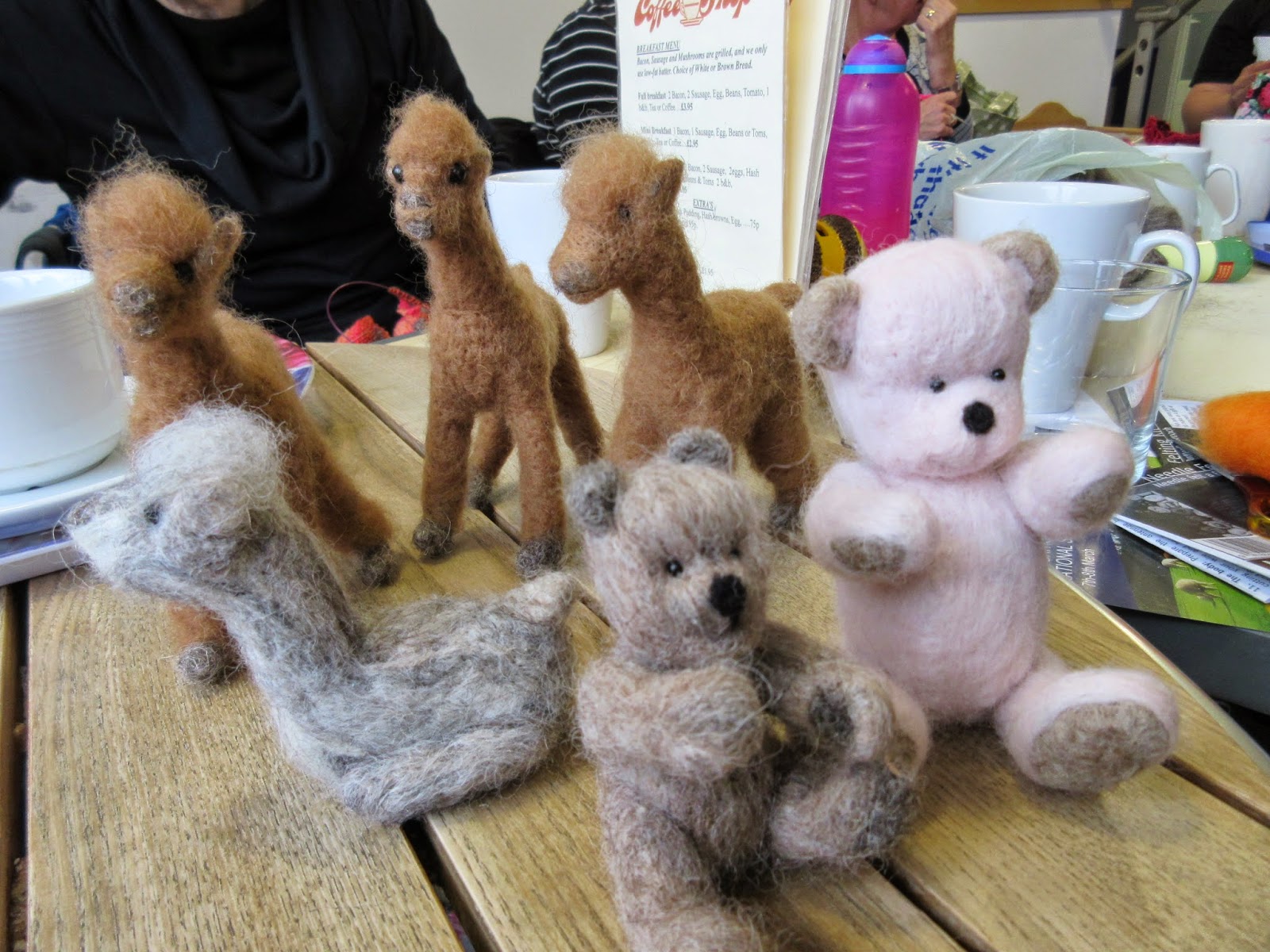
My knitting group has a connexion with this show and this week, Joy showed us some alpacas and teddies she has needle felted.  Jean has made an alpaca as well so when they were all on the table, I asked if I could photograph them and show them to all of you.  Here they are -
 
 
Lovely work, rubbish photo!  Cue much hilarity as somebody got out a jacket and laid it on the table to make a background, holding it up in front of her face -
 
 
By no means perfect but at least you can see the figures properly.  I thought the tiny teddies deserved a picture of their own - they are jointed! 
 
 
 We had so much fun doing this.  Very silly.  Here is Jean having a go at making a teddy -


Don't mess with her, she is armed and dangerous!  Meanwhile, Joy was working on this butterfly brooch -


The background fabric with the pattern drawn onto it is water-soluble and will dissolve once the felting is finished.  How clever.

As for me, I am not needle felting, I am knitting.  I was invited to take a skein of alpaca wool and knit a scarf for our hospice.  The wool is lovely, SO soft and warm and I wanted to do it justice so I looked online and found a new pattern HERE.  It's coming on well.


There is a postscript to all this: last Saturday we drove to Loughborough to visit The Mathematician and we went for a walk in Beacon Hill Country Park in the Charnwood Forest.   We had a lovely afternoon together, the sun popped out for a few moments so that I could photograph these catkins (it really must be nearly spring) -


We found these Highland and English Longhorn Cattle -
 
 
We got amazingly close to this kestrel before she flew away -
 
 
And lastly, we rounded a corner and found a field of sheep and ... alpacas!  We just couldn't believe it.  You see, The Mathematician had been researching places for us to visit and she had found an alpaca farm but decided against it because she thought the Best Beloved might be "all alpaca'd out" after coming to the National Show with me, and he had agreed that he was!  But I certainly wasn't and this made my day. 
 
 
 Gorgeous, or what?
 
Love, Mrs Tiggywinkle x

Sunday, 15 March 2015

My Nanny

Hello, thank you for popping in.  If you are in the UK, today is Mothering Sunday - not Mothers' Day, but historically, the day when people went to worship at their mother church.  Young people who were in domestic service were given the day off and walked home to their villages, picking wild flowers from the roadside to give to their mothers when they got there.   However, I love the fact that it has become a day to celebrate our mothers, mothering is hard work and one day in the whole year when this is recognised doesn't seem too much to ask.  I know that it can be a difficult day for those whose mothers have died, or indeed those mothers whose children have died, as well as those mothers and children who are not in contact with each other, but nevertheless, I think it is important to mark the day, and ignoring those we have loved and lost isn't helpful.  For me, it has never been about extravagant gifts, a card is sufficient and if it is homemade, so much the better. 
 
This year, however, Mothering Sunday has a special resonance for me because 15th March was my paternal grandmother's birthday.  Here she is, Julia May Spiers, never called Julia but always Julie or Ju - but known to her grandchildren and great-grandchildren as Nanny.  


She was born in Shoreditch in East London on 15th March 1912 and when she was two and a half years old, her father joined the army and went off to fight in the First World War.  She and her mother, Carrie, moved in with her father's family until he came home, severely injured, three years later.  Julie was an only child but had a large extended family, she was a good swimmer and a good singer, and at the age of 21 she married her sweetheart, Art, and they moved into a house in the same street as Julie's parents. 


Five and a half years later, in the summer of 1939, Carrie died and Julie's father moved in with her and Art.  My father was born in 1941 and two years later, Art was conscripted into the RAF and sent overseas for three years.  I have read that Carrie's generation of women lost their husbands to the First World War and their sons to the second and I feel grateful that the womenfolk in my family were not scarred in that way, but Julie was temporarily abandoned first by her father, then by her husband and although they came home, she didn't know that they would and I can't imagine how that must have changed her.  She miscarried a child while Art was away, conceived before he left, but gave birth to another son after Art came home.  So there she lived in a houseful of men - father, husband and two sons.  During the 1950s Julie became Akela to the local Cub Scouts - more boys to look after. 
 
So it must have been surprising when 5 granddaughters came along before a grandson.  I was the first, and here she is holding me at my Christening. 


See that sparkly dress?  That dress is so typical, she LOVED a bit of sparkle. 

In 1952 Julie became the caretaker of a church, a job which came with a house.  She looked after the church and all its associated rooms and activities - I can remember her taking me in to sit at the back of the church during weddings, going to Christmas bazaars and, on Tuesdays, the church's thrift shop.  Everyone knew me, of course they did, I was Julie's granddaughter!  My parents were married in that church, as were my aunt and uncle, and two of my sisters and I were christened there.  Julie had to retire from being Akela when she was 65 years old but she didn't retire from her job until 1989, when she was 77.  She once told me that in all that time, she never had a pay rise.  Can you imagine that, starting a job and being on the same salary 37 years later?  By the time she left, the organist was paid more than she was.

So, having lived in a very small patch of East London for all of her 77 years, 37 of them in the same house, Julie then moved to ...Cardiff, to be near my parents.  Can you imagine the culture shock?  And having lived in a 3-storey, Georgian terraced house with no back garden and no fitted kitchen situated on a main road with a bus stop outside the front gate, she and Art moved into a 1980s-built, 2-storey detached house with fitted kitchen, back garden and a lawn situated on an estate! 

Julie loved being with children and her weekly shop included a bag of sweets and chocolate bars which she took to church every Sunday to give to the children who were there.  They flocked around her after the service, waiting for her to open her capacious handbag.  At home, she kept a bowl full of sweets in her sideboard for her grandchildren and later, great-grandchildren.  I think it drove my mother to distraction when she broke the rules and offered them to us before our lunch!


Julie died in 2005, having lived to meet 7 great-grandchildren (that's The Teacher on her lap in the photo above) and I made sure that I wore a bit of sparkle to her funeral.  I know that I am very lucky to have had my grandmother in my life for 40 years.  I think of her often and I still miss her.  This is what she taught me: I cannot recall ever hearing her say a bad word about anyone.  I don't know if she thought it or not, but I never heard her say it.  She was the most non-judgmental person I have ever met.  When I was young, the fact that she didn't give me special attention when I won prizes or did really well in exams really bothered me, I felt that I had earned and deserved some acclaim, but as an adult I realised that she loved me simply because I was her granddaughter, unconditionally.  Simply because I was me, warts and all.  That's very powerful.
 
Happy Birthday Nanny.  You were very special and we miss you. 


Love, Mrs Tiggywinkle x

Friday, 13 March 2015

Daffodowndilly

Hello.  Thank you for calling in to my little Shropshire patch.  It feels as if winter is drawing to a close here, it's a bit warmer, the days are longer and we are looking to the spring.  Yesterday, 12th March, my first daffodils opened up so I thought I would take a turn around the garden and look for other signs of burgeoning life.  You see, we can't see the back garden from the house, we have a small yard at the back and then the garden proper is angled away so our view beyond the yard is of...our neighbours' garage!  It's not very picturesque.  It means that our garden has no winter interest as there's no point, we can't see it during the winter unless we go out in it for a purpose, which by and large, we don't. 


These crocuses in the old sink in my back yard opened up last weekend; the variety is Pickwick, lovely purple and white stripey petals.  This was snapped during the only moment of sunshine in the whole day. 


Here are the aforementioned daffs.  It was really windy and very difficult to photograph, this is the best I could get, but I really wanted to capture the day.  I LOVE it when the first daffs open up their trumpets of joy.  I always think of this poem, not the obvious Wordsworth but Alan Alexander Milne -
 
Daffodowndilly
 
She wore her yellow sun-bonnet,
She wore her greenest gown;
She turned to the south wind
And curtsied up and down.
She turned to the sunlight
And shook her yellow head,
And whispered to her neighbour:
"Winter is dead." 
 
Also in tubs in the back yard are these polyanthus, vivid jewels on a dull day bought very cheaply in Lidl a couple of months ago -


Under the hawthorn tree at the end of the yard there are sedums, new, fresh green rosettes


Further into the garden, the forsythia is in bud, bright green promises of gold -


and new little columbines, gathering and growing for a May spectacular -


But AA Milne was wrong, winter isn't dead yet, I'm an astronomical kind of gal rather than a meteorological one and I think that if you recognise the solstices, you also have to recognise the equinoxes and that means that spring begins this year on 20th March.  There's not long to go now but we are still in winter and I found this reminder at the bottom of the woodpile, a sign of death and decay in the fungi which fascinate me -


Now I know this is a bit random, but at the end of my yard there is a wall, just an ordinary, Victorian brick wall.  A few years ago we had some landscaping done in the garden and the builder said to me, "That's a lovely wall."  I was surprised and a bit nonplussed, I had always thought that a wall is a wall, so I looked at it with fresh eyes and found that I agreed with him, it is a lovely wall.  It's behind the hawthorn so it never sees the sun, but I thought you might like to see it.  I know.  I'm a bit bonkers.  I find beauty in old bits of brick wall and fungi.


So thank you for indulging me.  The light was dull, the plants were dancing in the wind and I am not getting to grips with my new camera as quickly as I had hoped, but I have marked the day, Daffodowndilly Day, and I am glad I did because the rain poured out of the sky last night and hasn't stopped yet. 
 
See you soon.
 
Love, Mrs Tiggywinkle x

Friday, 6 March 2015

'S Wonderful

Hello my lovelies.  Today I am going to introduce you to one of my oldest friends.  We have known each other since 1977.  We lost touch in 1985, I knew where she was but we had no contact until 2011 when I took the initiative to dig her out and re-establish our friendship.  Here she is -
 
 
A clarinet, a Boosey and Hawkes Regent, standard school issue in 1977.  I had lessons again for a couple of years and I intended to take exams, but my nerves wouldn't let me.  As my Grade 6 approached I felt like I was 15 years old again, I lost sleep and was literally sick with nerves, so I made a grown-up decision to back out and I haven't regretted it, even though if I passed Grade 6 I could teach beginners and earn some money, apparently. 
 
I am not a great player, but I do love to make music, especially with other people, so when my friend and erstwhile teacher asked me to give a recital with her, I agreed.  She is the organist HERE and once a month they hold a lunch followed by a short (very short, about 20 minutes) concert.  This is the third time I have played for them and the audience is small, informal and friendly, just what a nerve-wracked player like me needs.
 
The church is lovely.  This building was apparently built in about 1200, replacing an earlier building, but it had a major refurb in the 19th century, and the heating is definitely 20th century (a major consideration for musicians - you can't play with cold fingers!).


The ceiling has been painted red and pale blue.  I really like it.
 
 
There are some lovely stained glass windows: I particularly like this one, the church's war memorial.  Can you see the soldier and the sailor on the right?
 
 
I was taken by surprise when, during lunch (I can't eat much because I'm about to play a woodwind instrument!) someone said to me, "Are you our artist today?"  I was shocked into silence so she repeated her gentle question.  AN ARTIST!!!!!  I have never considered myself in that light before.  An Artist.  Wow.  And that is what I have learned as an adult player: you don't have to be a wonderful player to bring pleasure to other people AND TO YOURSELF.  How I wish I had known that when I was young, the nerves might not have crippled me.  Fear of failure is very debilitating.
 
So we played some pieces and I played a couple of Gershwin solos (ooh, palindrome!) and each of us read a poem.  I chose this one by Emma Chatonoir-
 

Who wouldn't want
To kiss a clarinetist
The most reserved members
Of the band
Half of the section
Is already in a relationship
But half of the section
Is almost always single
And oh my goodness
The players
The players are beautiful
Not like flute beauty, better
Playing the somber tone
With dark timbre giving you goosebumps
Up to the screaming high notes
That don't sound musical, yet still work
Reed their lips
Clarinet is life
But you are love
Or at least to them
Clarinet players are the best kissers
And the sweetest people you'll meet
And they would risk a broken reed
Just to be close to you
.


I have never kissed a clarinet player so you would have to ask the Best Beloved!

Love, Mrs Tiggywinkle x