Saturday, 23 April 2016

Five on Shakespeare

Hello, thank you for calling in.  Today I am joining in with Amy at Love Made My Home for Five on Friday, so thank you, Amy, for organising the party and joining us all together.  You are a star.

So, today is 23rd April, England's national day.  To be honest, I find it difficult to get excited about St George.  There, I've said it.  Unpatriotic of me, I know, but I just don't feel any connexion with him.  St David and St Patrick, boys from the British Isles whose feet trod our landscape, yes; a knight from the Middle East who never came within a thousand miles of England and was randomly adopted as our patron saint by a king who spent most of his life in France and barely spoke English?  No.  William Shakespeare, a great Englishman who left a gift for the world, saves the day: 23rd April was the day he died and today is the 400th anniversary of that day.
 
The Best Beloved took this photo in Holy Trinity Church, Stratford-upon-Avon, in 2008.
 
All British children study Shakespeare's plays at school and there are very good reasons for that.  For a start, many familiar phrases originated in his work: green-eyed monster, eaten out of house and home, a foregone conclusion, brave new world... thank you, Will Shakespeare.  Secondly, the themes are universal and as relevant now as they were in the sixteenth century: both Cole Porter's Kiss Me Kate and 10 Things I Hate About You are The Taming of the Shrew, West Side Story is Romeo and Juliet, Forbidden Planet is The Tempest and The Lion King is Hamlet with a happy ending (after all, it is Disney).  The problem for modern children is the language, removed as it is from the English we read and speak today. 

When I was a teenager I was fortunate to live within an hour's drive of the West End of London which meant that there were plenty of opportunities to see the Bard's work performed which, of course, is the key to engaging with Shakespeare: he wrote plays to be performed by actors who understood the meaning of his words and were trained to convey that meaning to the audience, not texts to be read by bewildered first-formers.  My teachers understood that and so off we went to the theatre whenever we could to see those texts come alive.  So today my Five celebrates five of those plays, memories illustrated by the programmes I have kept.

1. The Merchant of Venice


This was the first Shakespeare play I studied and the first I saw on the stage, in this case at the Young Vic.  On the back I have written "School English Trip 15th November 1979" so I was fourteen years old.  Modern setting, Shakespeare's words, no problem.  This one was directed by Michael Attenborough.

2. Othello


Ah, now this one really was something special: Othello at the National Theatre with Paul Scofield and Felicity Kendal, directed by  Sir Peter Hall.  Michael Bryant was a spellbinding Iago.  The programme cost 40p and I have written "School Trip 1st March 1981" on the back, very handy as I sat my O-Levels three months later and this was a set text.

3.  The Taming of The Shrew


On summer evenings all over England you can find hardy souls wrapped in blankets and cagoules, enjoying picnics and watching Shakespeare performed in the open air.  It's a wonderful tradition!  In fact, the first Shakespeare play we took The Mathematician to see was The Tempest, performed in the open air and preceded by...a tempest!  The redoubtable players said that as long as there was an audience, they would perform.  Marvellous!  On 9th June 1982 I was at the Open Air Theatre at Regent's Park in its Golden Jubilee Season watching The Taming of the Shrew. Kate O'Mara was a wonderful and memorable Katherine (although, sssh!, I must say that I really don't like the misogynist theme of this play, despite the fact that I have seen it at least four times!).

4. As You Like It


This was an amateur production - I'm not fussy, as long as it's good I really don't mind if the company is paid or unpaid.  The Chapter Garden of Windsor Castle made a leafy and lovely Forest of Arden and I knew several of the actors including the absolutely wonderful David Thomas, the deputy headteacher at my school, teacher of history, architecture, mathematics and history of art, ardent monarchist, director of ambitious school plays and leader of school trips to Italy, who played Touchstone and produced and designed this performance.  On the back I have written that this was Thursday 23rd July 1981 and that I went with Mum, Dad and my sister. 

5.  Much Ado About Nothing
 
 
I studied Much Ado About Nothing for A-Level English and in this case, familiarity has certainly not bred contempt (I think that's Aesop rather than Shakespeare) for it's my favourite Shakespeare play.  I have seen it five times and this was not only the best of those, it is quite simply the best play I have ever seen.  It was outstanding.  I remember it so well, Sinead Cusack and Derek Jacobi sparkling as Beatrice and Benedick, the mirrored floor of the stage at the newly-opened Barbican Centre, the dancing, the torches... I was wonderfully transported to another world and I still hold the pictures in my head.  To my great annoyance, I haven't written the date on the back but this cast list shows that The Taming of the Shrew and King Lear were also being performed that season and as I went to those too, and did write the dates on the backs, I know that it must have been the spring of 1983.
 
Oh, how I have enjoyed going through my theatre programmes, remembering nights out with friends, with family, with boyfriends and later, with The Best Beloved and our children.  I have known for months that I wanted to commemorate Shakespeare today but I didn't know how I wanted to do that until my last post, when I suddenly realised the way for me to raise my personal metaphorical toast to the great Bard was to share these early experiences with you in this way.  Thank you for indulging me.  Now if you have time, please hop over to Rosie's blog because she is celebrating the day in the same way - except that it's different, because we have seen different productions and she has an absolute WOWSER at number five.  I was a bit stunned when I read her blog yesterday and saw that we were thinking along the same lines, but that's what Shakespeare's about, I think, the universal experience.
 
Today I am off to the Wenlock Poetry Festival for the day to enjoy some contemporary poetry, but I'm sure there will be a nod to Shakespeare.  We can't really get away from him.
So farewell, the elements be kind to thee and make thy spirits all of comfort (Antony and Cleopatra).
 
See you soon.
 
Love, Mrs Tiggywinkle x

Monday, 4 April 2016

Strange Forces At Work

Hello, thank you for dropping in.  My last post was about Dame Judi Dench's inauspicious London theatre debut by way of the 1982 Royal Shakespeare Company's production of The Winter's Tale and having seen this morning's news, I feel I need to write again. 
 
The Olivier Awards are given to recognise excellence in professional theatre in London and they are generally regarded as the highest honour in British theatre.  Last night, Dame Judi Dench received the award for Best Actress in a Supporting Role for playing Paulina in.....The Winter's Tale.  In the 1982 production which I saw, the role of Paulina was played by Sheila Hancock, who was also nominated for the Olivier Award that year, although the prize was ultimately awarded to Anna Massey for her performance in The Importance of Being Earnest, a play in which Dame Judi was nominated for Actress of the Year in a Revival for her performance as Lady Bracknell, although she didn't win, either.  Are you still with me?!
 
I am ever-so-slightly reeling.  Now then, I don't believe in coincidence, but I wonder what it was that drew me to choose that particular theatre programme to write about last week and to choose to relate it to my own 1982 theatre visit?  There were many others to choose from.  I didn't know that Dame Judi played in The Winter's Tale last year, or that the Olivier Awards ceremony was this weekend; at least, I don't think I knew.  And when I drew a little-used book from the shelf yesterday, a book which I have had for more than thirty years, a small clutch of theatre tickets fell from the pages, including this one -


As I said, I don't believe in coincidence...
 
See you soon.
 
Love, Mrs Tiggywinkle x

Saturday, 2 April 2016

A green girl, unsifted in such perilous circumstance

Hello, thank you for popping in.  I am still thrilled to bits that anyone is reading.  It's Easter holiday time here which means that The Mathematician is home for four weeks and the Best Beloved is off work for a fortnight.  I am still at work but I am off enforced kitchen duties, so that's a rest for me, too.  Everyone in our house is quite relaxed, the pace is slower, we are catching up on lost sleep, the days are sunnier, the evenings are lighter and the birds are building their nests.  Spring has sprung.
 
We spent Easter at my parents' home in South Wales and were thoroughly pampered, which was lovely because I was completely worn out by the time we got there.  There were no bunnies, chicks, pastels or artful table decorations; we had a birthday celebration, a traditional (old-fashioned?) church service, a roast lamb dinner, chocolate, nephews and a niece, family time, the Boat Race on television, a proper rest and a nostalgic peruse through old photographs and theatre programmes.  It was just about perfect.
 
One of the things I like about old theatre programmes is discovering a name in the cast list which has since become extremely well-known.  For example, when I was seventeen years old and saw a young, red-headed Leontes dancing with his son in Shakespeare's The Winter's Tale I had no idea that Patrick Stewart would become internationally famous within a decade as the captain of the USS Enterprise.  In 1957/8, my father went on a school trip to the Old Vic in London and saw this production of Hamlet -


Now take a close look and see who was playing Ophelia in her London debut -


Yes, a young Dame Judi Dench, straight out of drama school then and now a "national treasure".  However, the reviews of her performance were not good: in The Observer, Kenneth Tynan praised the production but wrote that "The Ophelia, Judi Dench, is a pleasing but terribly sane little thing", a strong sign that something was amiss if you recall that Ophelia is supposed to lose her sanity during the course of the play.  Another well-respected theatre critic, Richard Findlater, wrote "The debut was, in my view, a debacle." 

 
English actress Judi Dench as Ophelia at a dress rehearsal of Michael Benthall's production of Shakespeare's 'Hamlet' at the Old Vic, London, 15th September 1957.
 
In the long term I don't think those notices have impeded her career!
 
See you soon.
 
Love, Mrs Tiggywinkle x

Saturday, 19 March 2016

St Bartholomew's Church, Moreton Corbet


Hello, thank you for dropping in.  I am delighted that so many of you enjoyed our little outing to Moreton Corbet Castle and today, I am going to show you the parish church,
St Bartholomew's, which stands only a few steps away.

I pushed open the heavy, boarded doors and stepped into the gloomy 12th century nave.


There is a list of rectors of this church, a list unbroken since the year 1300, displayed in a frame.  Christians have been worshipping here for more than 700 years but I had little sense that this is a House of God.  However, it is certainly a House of the Corbets.  There are memorials here of all shapes and sizes to members of the Corbet family, from marble tablets on the wall to painted tomb chests including this one -


This chest commemorates Richard Corbet, who died in 1567, and his wife, Margaret Savile.  Their colourful coats of arms surround the chest, the power of the Corbets symbolised by the elephant and castle and the wisdom of the Saviles represented by the owl.  The swaddled baby in the middle must represent a child who died in infancy as Richard had no surviving children and when he died, his Shropshire lands were inherited by his nephew, Sir Andrew, the man who extended the castle.
 
 
Obviously, the grand Corbets couldn't be expected to sit with the common people of the parish and in 1778 a "squire's pew" was added.  This three-sided room off the south aisle had a fireplace to keep the grandees warm, cushioned pews and curtains which they could pull across so that they wouldn't have to gaze upon/smell the hoi polloi.  This enormous memorial to another Richard Corbet, a royalist soldier who died in 1691, fills one corner of the room.
 
 
In 1883, Vincent Rowland Corbet, 3rd Baronet, paid for the refurbishment of the church and after he died in 1891, the family installed this window in the south aisle in his memory.  Entitled "Suffer Little Children" and made by the renowned firm Clayton and Bell, it depicts the passage in the bible in which Jesus exhorts his disciples to let the children come to him and it's quite charming.  Now, I know almost nothing about stained glass, but when I got home I looked up Clayton and Bell and was intrigued to discover that their windows can be found in Switzerland, Canada, the USA, Australia and New Zealand - as well as in St Peter's Church in Burnham (please excuse this personal reference, but I know that some of you are  familiar with St Peter's).  You can read more here if you are interested.
 
 
In 1904, Vincent Stewart Corbet, the son of the 4th Baronet, died of appendicitis; he was thirteen years old and a student at Eton College.  His parents commissioned Sir Ninian Comper, the great Gothic Revival architect who would go on to design windows for Westminster Abbey, to refurbish the chancel and replace the east window in his memory in 1905 and this is the result.  If you look very closely you may be able to make out the alabaster elephants on either side of the window's central bottom panel.  The refurbishment included a golden canopy on the ceiling -
 
 
There is another memorial to this boy outside in the churchyard, a carved stone plinth which once bore a bronze statue of Mercury.  The carving is rather beautiful and depicts two emblems of the Corbets, the elephant and castle and the squirrel. along with their respective mottoes: Virtutis Laus Actio (The Praise of Virtue is Action) and Dum Spiro Spero (Where There Is Breath, There Is Hope).  This poignant memorial tells a sad tale, for in 1910 Vincent's mother, Lady Caroline, added the name of her husband, Walter Orlando Corbet, and in 1915 she added the name of Vincent's younger brother, Rowland James Corbet, killed in action in France fighting the Great War; her husband and both sons dead within the space of eleven years.


It is a fascinating place to visit, displaying more than six hundred years of the history of the one family and how the English fashion for celebrating the lives of the rich and powerful has changed during that time - and holding the Corbet family's present as well as its past, for Christopher Corbet is the churchwarden. 

See you soon.
 
Love, Mrs Tiggywinkle x


Tuesday, 15 March 2016

A Sunny Sunday at Moreton Corbet

Hello, thank you SO much for your comments on my last post, I love to read your comments and the Best Beloved thanks you too; he is delighted that you liked his birdie photos.  

Spring is almost here: daffodils are nodding their heads and the crocuses are opening their faces up to bask in the periodic sunshine.  It's light when the Best Beloved leaves for work just before 7am and I watched a glorious sunset while I waited for him to pick me up yesterday at 6.30pm, waves of pink sweeping across the dark blue sky as the sun sank in a bank of amber and gold.  However, if you've been reading here for a while you will know that I am an astronomical kind of gal and in my book, it's not spring until the solstice next week, so although spring is almost here, winter is not quite done with us yet.

On Sunday, however, it did feel like spring as the sun shone and the birds sang, the Best Beloved even saw a butterfly (which is really annoying because he can't tell you any of their names) so when he suggested we go "out somewhere", he knew that he was pushing at an open door.  We really should have stayed at home and worked on the garden, neglected all winter, that would have been the sensible, grown-up thing to do, but I felt a blog post calling, so off out we went to place I have been wanting to share with you: Moreton Corbet Castle.


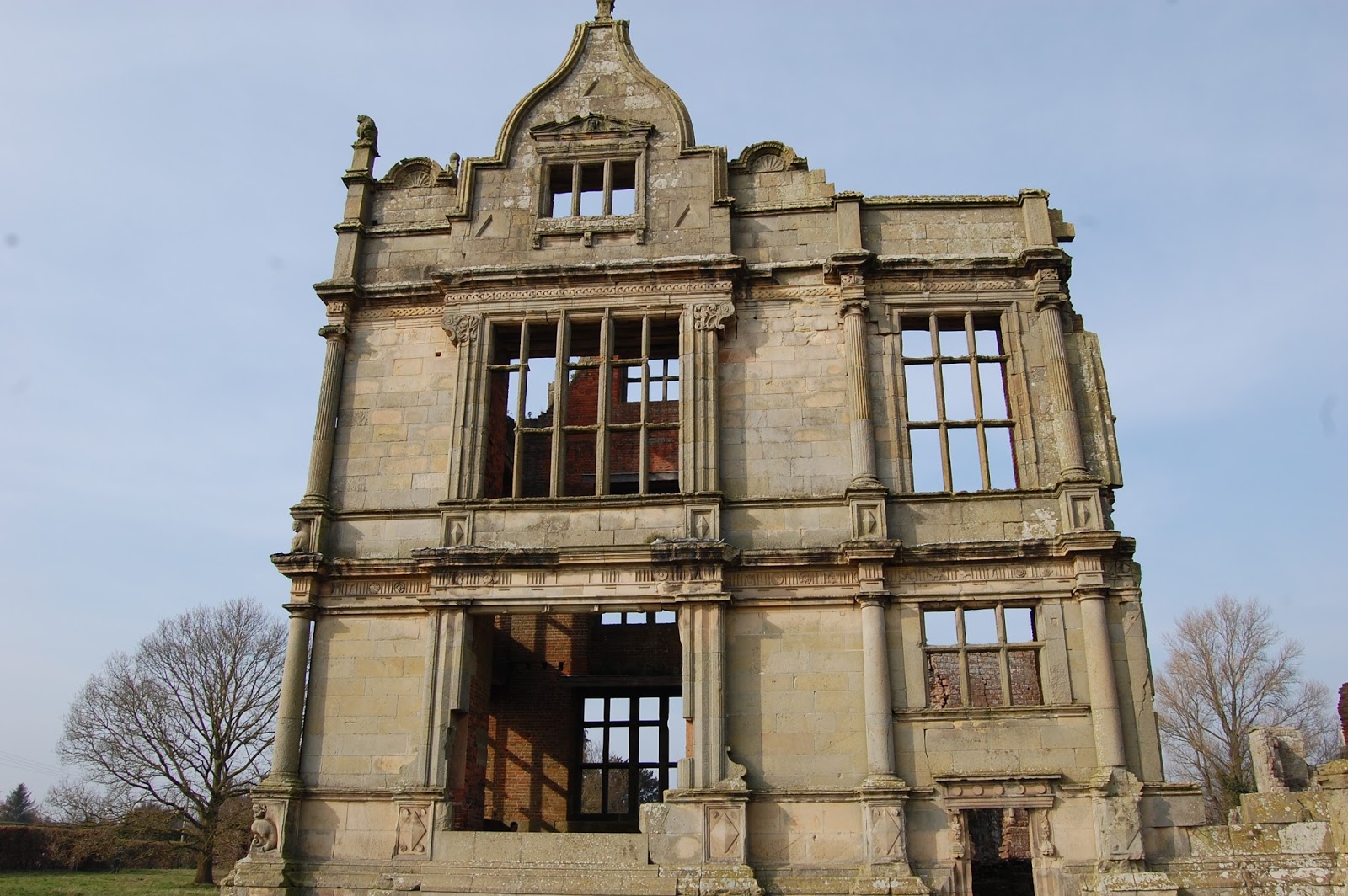
I love to visit old places.  Do you?  I like to tread the paths which others have trod hundreds of years before me, to place my hand on the stones they dressed and laid, to look at views which they would have looked like and feel their stories travelling through the centuries, to feel the connexions between their lives and mine.  Moreton Corbet is such a place.  In the 12th century the land was owned by the Toret family and in about the year 1200 they replaced the earth and timber structure which was there with a great sandstone keep, surrounding it with a curtain wall with an imposing gatehouse - remember that these were still violent times and an Englishman had to protect his castle.  When Bartholomew Toret died in 1239 without a male heir, the land and its castle passed to his daughter, Joan, except, of course, that married women were not allowed to legally own ANYTHING in this country until 1870, so in fact the land passed to her husband, Richard de Corbet, and so Moreton Toret became Moreton Corbet.  Seven hundred and seventy-seven years later, the Castle still belongs to the Corbet family, who live locally.  Shropshire's a bit like that.

 
Let's move forward in time 330 years or so, to the 1560s.  By this time, Queen Elizabeth I was ruling England and Sir Andrew Corbet had inherited the castle.  He decided to do some remodelling, building a range of domestic buildings inside the curtain wall and developing the castle into a comfortable manor house.  


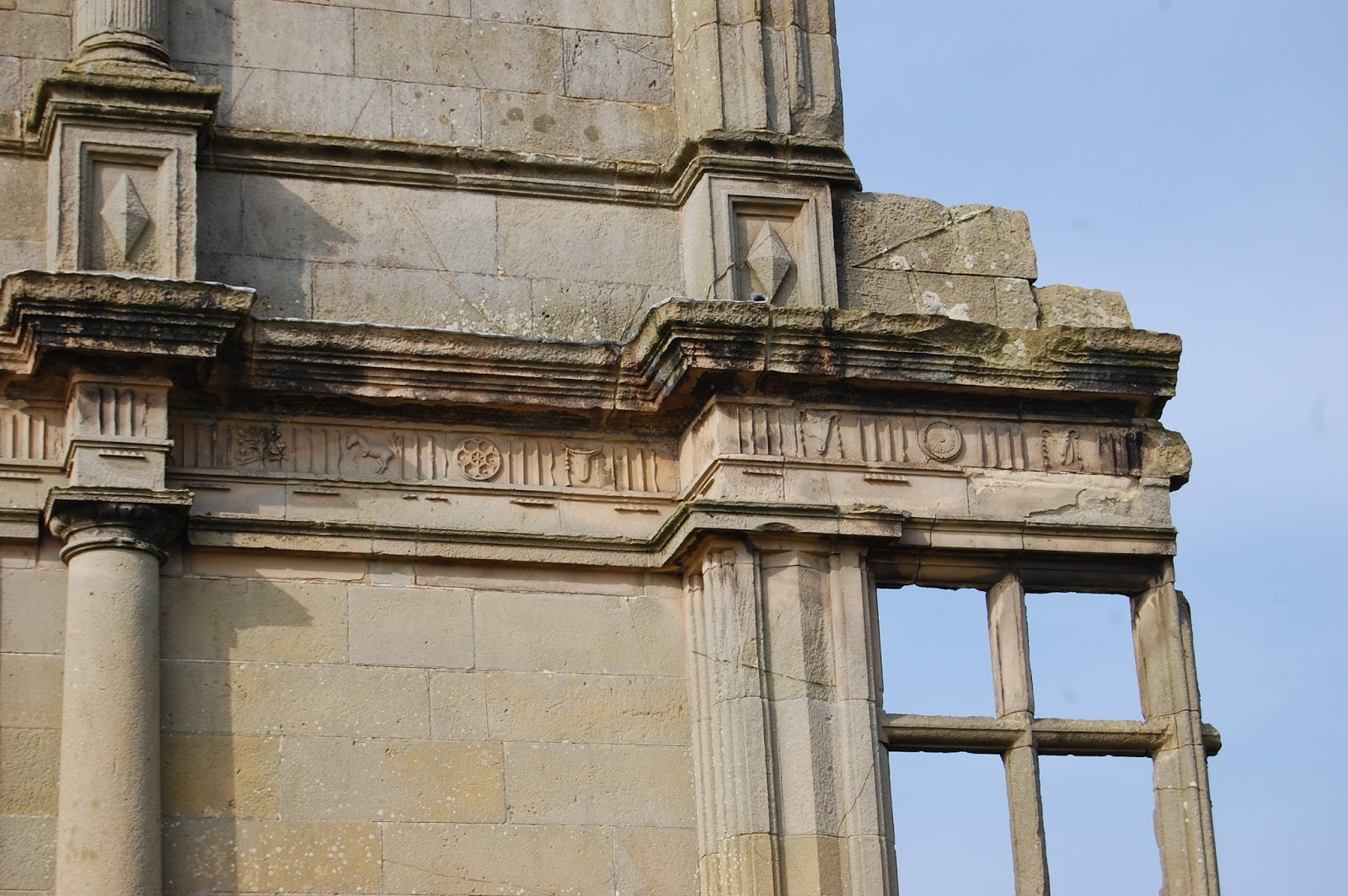
When Sir Andrew died in 1578, his son, Robert, inherited the castle and continued his father's work. Robert, however, didn't really want to live in a Medieval castle, despite its makeover; he had travelled extensively in Europe and represented the government as an ambassador to The Netherlands.  His tastes were more sophisticated, he spoke fluent Italian and he was obviously enamoured of the new Italian style of architecture, so he set about the construction of a new range of buildings immediately south of the old castle, brick-built and faced with stone, elaborately carved and decorated.  Sitting in the middle of the fields of rural Shropshire it was absolutely extraordinary, and its remains still take your breath away.


Robert died of the plague in London in 1583, before his new home was finished and although his brothers Richard and then Vincent took over, the work was never fully completed.  During the Civil War in the 1640s the castle was damaged, eventually being taken by the Parliamentarians, and although it was restored to the Corbet family afterwards and repaired, it was abandoned in the early 18th century and mother nature has taken hold, dismantling the walls and wearing away the stones.  It is a lovely place to spend an hour or so, a quiet and peaceful place surrounded by fields and sheep, accompanied by the occasional butterfly or pheasant, a place where you can feel the hundreds of years of history which have drawn you there.  It's free to visit and open during daylight hours, just park your car in the layby and open the gate...

 
There is a little church there too, built around the time that Bartholomew Toret built his great stone keep, a fascinating church with much to see, but I shall save that for next time.  


See you very soon.

Love, Mrs Tiggywinkle x


Saturday, 27 February 2016

Five On Friday - Birdwatching

Hello, thank you for dropping in, especially if you have come here via Amy at Love Made My Home.  Thank you very much if you left a comment on my last post - I was quite overwhelmed, and for those of you who were wondering, no, we don't keep a pig in our sty, all we have left of it is one wall and the brick floor, which we have extended with the bricks which used to make the other walls so that we can use it as a patio.  We actually refer to it as "the pigsty patio" which seems to horrify some people.  When it's all lovely in the summer, I'll show you.  I was fascinated to learn that in the USA, pigsties and privies were built of wood rather than brick - one of things I enjoy most about Blogland is the window it gives onto other parts of the world.  It also seems that quite a few of us have childhood experiences of outdoor loos and you may be appalled to hear that when I was at university in 1985 the house I lived in had no indoor loo! 
 
Last weekend the Best Beloved and I went on a little jaunt to North Wales.  Our first stop was The Spinnies, a nature reserve just outside Bangor which we haven't been to before.  A short walk took us to a bird hide which looked out onto a small lagoon.  Unfortunately, the very windy weather had sent most of the aquatic birds into the shelter of the reeds so we didn't see as many as I had hoped to see, but there were plenty of little birdies on the feeders and the Best Beloved took some pretty photos which I thought I'd share with you.  So here are four common British birds and one rather rarer one.
 
1.  Nuthatch
 
 
I have occasionally seen nuthatches in the woods but I have never been this close to one before.  I think they are one of my favourites. 
 
2.  Mr Chaffinch
 
 
The chaffinch is one of the commonest garden birds in Britain but I have never seen one in my garden.  (Don't worry, I have seen plenty of other birds, just not one of these.)
 
3.  Mrs Chaffinch
 
 
Ah, now here is his wife, looking rather plainer than her dandy of a husband. 
 
4.  House Sparrows
 
 
Numbers of house sparrows have declined drastically over the last forty years, perhaps by more than 70%, so I appreciate them a lot more than I used to, but there was no shortage of them here at The Spinnies.
 
5.  Little Egret


Now here is the star of the show and I am sorry that this is the closest we could get - it's a small, white heron with black legs and big, yellow feet.  According to my bird book, published in 1993, this bird is a "scarce visitor" to this country but apparently, they first bred here in Dorset in 1996 and are now seen in a number of places on the south coast of England...and in Wales, obviously.  This is only the second time I have seen one and we watched it for a long time.  Magnificent, especially when it stretched its wings and flew.
 
So, I hope you enjoyed this little ornithological post.  If you have time, you might want to hop over to Love Made My Home and see who else is joining in with Five On Friday this week.
 
See you soon.
 
Love, Mrs Tiggywinkle x

Friday, 19 February 2016

Five On Friday - The Tollhouse

Hello, thank you for dropping in, especially if you have come here via the lovely Amy at Love Made My Home, you are all very welcome.  Today is the first anniversary of Five On Friday so first of all THANK YOU to Amy for setting it up and hosting for us. 
 
The Best Beloved and I have been back to visit Blists Hill Victorian Town in Madeley in Telford and today I would like to show you the tollhouse.  Designed by Thomas Telford, the county surveyor after whom the new town was named, it was built in the early nineteenth century and stood on the Holyhead Road, now the A5, north of Shrewsbury.  When the road was widened in the early 1970s, the tollhouse was due to be demolished but instead it was rescued, dismantled brick-by-brick and rebuilt here at the open air museum.


Shall we go inside?  If we go through the parlour at the front of the house we can go straight into the kitchen, the heart of the home, where the fire was lit for warmth and for cooking -


There are two bedrooms; here is the master bedroom, with a wooden cradle on the left, right beside the bed -


and here is the bedroom in which the children would have slept, four or five of them -


The patchwork cover on the bed and the rag rug on the floor were matters of necessity in times when money was short and nothing could be wasted.
 
Outside the house, there is a garden in which vegetables were grown to feed the family.  There is also one of these -


Do you know what it is?  The lower building on the left with the wall around it is a pig sty.  Every year, the family would rear a pig, fattening it up before slaughtering it for the family table.  The winter frosts would clean the empty sty before a new piglet was bought the following spring.  The building attached to the right is the privy (toilet).  Well, I suppose it made sense to keep all your stinky smells in the same place!  Gentle reader, I have a special reason for showing you this little building: I live in a little Victorian terraced house and when I moved in, there was in the garden the ruins of a little brick building.  These same ruins were in our neighbours' gardens too, and I eventually discovered that each house was built with a pig sty in its garden.  However, having worked out the footprint of the sty, we just couldn't work out what the extra bit was for and it was only when we visited Blists Hill and I saw this, several years later, that I realised it was the privy.  So there would have been a set-up exactly like this in my back garden.
 
I hope you have enjoyed my five pictures of the tollhouse at Blists Hill.  If you would like to find out more about it, have a look here, and if you have time, pop over to Love Made My Home and see what everyone else is sharing this week.
 
See you soon.
 
Love, Mrs Tiggywinkle x